Mold is not a seasonal problem on the Gulf Coast. Mobile sits at the head of the bay and takes roughly 66 inches of rain in an average year, spread across every season rather than one wet stretch, and the air stays heavy between the storms. That combination means a building here does not need a flood to grow mold. It needs a slow leak under a raised floor, a supply line that ran while a rental in Gulf Shores or Orange Beach sat empty, or a house closed up over a warm week with the air conditioning turned off. Spores are already present in every structure on this coast, and the building itself is the food source. Moisture is the only variable anyone actually controls, and this climate supplies moisture for free. United Water Restoration Group of Mobile treats mold as a moisture problem first and a cleaning problem second. We find the water that fed the growth and stop it, contain the work area under negative pressure so the remediation does not spread the problem into rooms that were fine, remove what cannot be saved, and dry the structure back to a documented target.
Why mold is a year-round problem here
Mold needs three things: spores, a food source, and water. The first two are everywhere. Spores drift in through every open door on the coast, and the food source is the building itself, the paper facing on drywall, wood framing, dust in carpet backing, the cardboard in the back of a closet. Water is the only variable anyone controls, and around Mobile Bay it is rarely in short supply. Roughly 66 inches of rain falls in an average year, and unlike climates with one wet season it arrives in every month. Between the rain, the outdoor air itself carries a heavy moisture load.
That changes the arithmetic. Inland, a mold call usually follows an obvious event, a burst line or a flooded room. Here it often follows nothing at all. A house shut up for a warm week with the thermostat set high will pull enough humidity into wall cavities and closets for growth to start on its own. A room that was dried after a small leak with box fans and open windows, instead of with dehumidification, was never actually dried. It was ventilated with humid air. Hurricane season adds the obvious exposure, wind-driven rain past a window flange or surge pushing up the bay, but the quiet failures outnumber the dramatic ones by a wide margin.
The practical consequence is that growth here is usually older than the owner thinks. Odor arrives first, a musty smell that is stronger in the morning or right after the air handler runs. Visible staining is a late symptom. By the time a dark patch shows on the finished side of a wall, the colony on the cavity side has normally been established for weeks.
The moisture source comes before anything else
Cleaning mold without finding the water that fed it produces a house that looks fine and smells the same six weeks later. So the first visit is an inspection, not a demolition. We map moisture rather than guess at it, using a thermal camera to locate the cool, wet areas behind finishes that look perfectly dry, then confirming every one of those areas with a moisture meter before anyone opens a wall. Temperature and relative humidity get logged in the affected space and in an unaffected room, because a reading only means something next to a baseline. Where water is still standing, extraction comes first, since no drying plan works around a wet floor.
The sources we find on this coast fall into a few repeated patterns. Supply lines and angle stops under sinks and behind toilets that have wept for months. Condensate lines from the air handler that backed up, overflowed the pan and soaked the ceiling below. Air handlers sitting in an unconditioned attic or closet that sweat all summer. Ductwork with failed insulation running through hot, humid space, where condensation forms on the outside of the duct and drips into the ceiling. Window and door flashing that lets wind-driven rain into a wall assembly. Roof penetrations opened by a storm. Under raised houses, plumbing that has been leaking into the crawl space for a season and feeding growth on the subfloor from below.
We do not begin removal until that source is stopped, or, when a licensed trade is required, until the repair is scheduled and the water is shut off. It is the whole difference between remediation and rework.
Containment, negative pressure and HEPA filtration
Disturbing mold makes it airborne. Cutting a piece of drywall out of an affected wall releases far more spores into the room than the wall was releasing on its own, which is why untrained demolition routinely turns a contained problem in one room into a whole-house problem. Containment exists to prevent exactly that.
Before any material comes out, we build a barrier around the work area, normally 6-mil polyethylene sealed to the floor, ceiling and walls, with a zippered entry and, on larger jobs, a decontamination chamber so that workers and equipment are not carrying contamination out with them. Openings into the rest of the building are sealed. Supply and return registers inside the containment are covered so the HVAC system cannot distribute spores through the ductwork into rooms that were never affected.
Then the enclosure is put under negative pressure. A HEPA-filtered air scrubber pulls air out of the work area and exhausts it outside, so the containment sits at slightly lower pressure than the rooms around it. Air moves into the enclosure through any small gap rather than out of it, and you can see the poly draw inward when it is working properly. Scrubbers run continuously through the job to filter particulate out of the air inside, and surfaces are cleaned with HEPA vacuums rather than shop vacuums, which pass fine spores straight through the filter and back into the room.
Removal follows the containment, never the other way around. Porous material that is colonized, drywall, insulation, carpet pad, ceiling tile, gets bagged inside the enclosure and carried out sealed. Framing and other semi-porous material is usually cleaned in place by HEPA vacuuming and damp wiping, then sanded or media blasted where growth has bound into the wood grain, and treated with an antimicrobial once it is clean.
Crawl spaces, slabs and beach condos fail differently
Three kinds of building fail three different ways around this bay, and the plan changes with each one.
Midtown and the historic districts, Oakleigh Garden, De Tonti Square and Church Street East, are largely raised pier-and-beam over a crawl space. The crawl space is the single largest mold variable in those houses. Ground moisture evaporates upward, humid outdoor air comes in through the vents and condenses on cooler surfaces, and the subfloor stays damp with no leak involved at all. Growth starts on the underside of the subfloor and the joists, and the first thing anyone notices upstairs is odor or a floor gone soft underfoot. Remediation there works from below: clean the framing, then control the moisture that would otherwise bring the growth straight back. A sealed vapor barrier laid across the soil and lapped up the piers cuts off the ground as a moisture source, and grading and downspout work keeps rainwater from running under the house to begin with.
Across the bay in Baldwin County, Daphne, Fairhope and Foley, the newer subdivisions sit on slab-on-grade. Water has nowhere to fall, so it travels sideways under the flooring, reaches the bottom plate of a wall and wicks up the drywall from below. Nothing is visible from the hallway until the baseboard swells or the paint bubbles along the floor line. Mapping is what finds the real extent, and removal usually means cuts above the wet line with the bottom plate and the back of the cavity cleaned and dried.
On the beaches, Gulf Shores and Orange Beach, the stock is mid-rise condo and vacation rental with direct Gulf exposure. A unit can sit empty for weeks between guests while a supply line runs or an air handler sweats, so discovery is late by definition. Stacked construction means one unit's failure reaches the floors below it, and containment has to account for shared walls, chases and a building-wide HVAC system.
IICRC S520, drying to a number, and independent clearance
Our work follows the IICRC S520 standard for mold remediation, alongside S500 for the water damage that usually caused it. S520 defines the condition we are returning the building to: no visible growth, no settled spore-carrying dust left behind, and moisture brought back to a level where growth cannot restart. It also sets out the part most often skipped, which is that remediation is not finished when the mold is gone. It is finished when the building is dry.
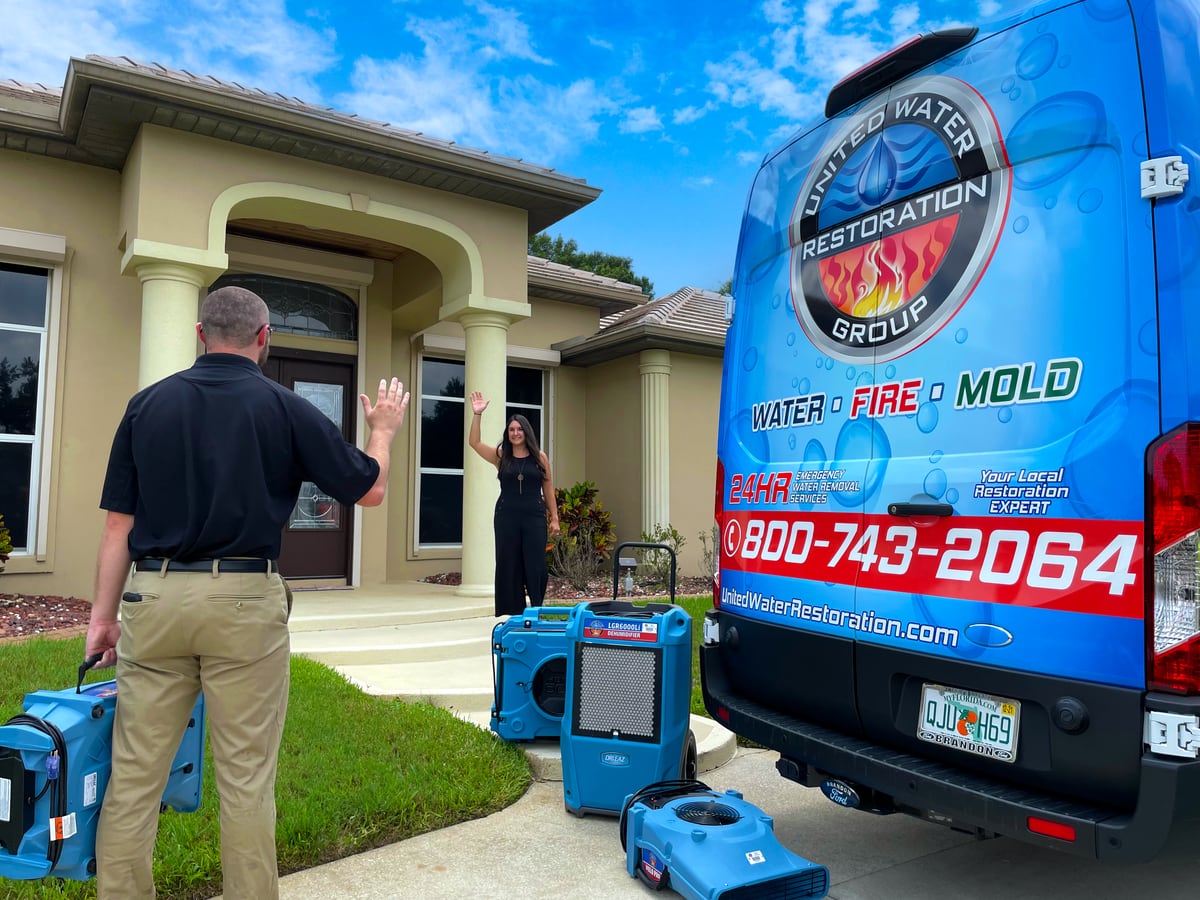
So drying runs on instruments, not on a calendar. Commercial dehumidifiers pull the moisture load out of the air while air movers push air across wet surfaces to keep evaporation going, and readings are taken daily on the affected materials and on unaffected material of the same type as a dry standard. Those numbers, with temperature and relative humidity in the space, go into a daily log. In this climate the dehumidification is the work and the fans are the assistant, because ventilating with outdoor air on the Gulf Coast usually adds moisture instead of removing it.
Verification should not come from the company that did the removal. We ask an independent indoor environmental professional to perform clearance testing, a visual inspection plus air and surface sampling compared against an outdoor control sample, and we leave containment standing until those results come back. It is the only honest way to prove the job is done, and it is what an adjuster, a property manager or the next buyer is going to ask for.
The file we hand over carries the same weight. Photographs before, during and after, a moisture map, the daily drying log, a written scope of what was removed and why, and the clearance report. That documentation is what supports an insurance claim. We work with carriers and adjusters routinely, but we build the file so it stands on its own.