A fire is over in minutes. What it leaves behind keeps working for days. Smoke does not stay in the room that burned. It rides the air currents a building already has, pushed by heat and pressure into wall cavities, closets, ductwork and the underside of floors. Soot settles on every cool surface it can find, and on the Gulf Coast it settles into air that carries moisture in every season, which makes it cling and makes it bite. United Water Restoration Group of Mobile works out of 3710 Halls Mill Rd A and sends crews across the county and over the bay to Daphne, Fairhope and the beach towns for exactly this work: stabilising the building, stopping the damage that is still spreading, cleaning what can be cleaned, and getting the odour out at its source rather than painting over it. The first hours matter less for drama than for chemistry. What gets secured, extracted and neutralised today costs a fraction of what gets replaced next month. Call (251) 351-8100 and we will tell you what needs to happen first.
Why smoke ends up in rooms the fire never reached
Heat makes pressure, and pressure moves air. While a fire burns, the hot smoke column rises and pushes into every gap the building offers: the opening around a light fixture, the chase behind a kitchen cabinet, the hole where plumbing passes through the top plate, the return side of the air handler. When the fire is out and the structure cools, that pressure reverses and draws the residue deeper into the cavities it just filled. That is why a bedroom at the far end of the hall can smell strongly and show a grey film on the ceiling when nothing in it ever burned.
How a house is built here decides where the smoke goes next. In Midtown and the historic streets around Oakleigh Garden, De Tonti Square and Church Street East, most homes sit raised on pier and beam over a crawl space. Smoke travels down through floor penetrations into that crawl space, hangs in still humid air, and comes back up through the same openings for weeks. The newer subdivisions across the bay in Daphne, Fairhope and Foley are slab on grade, so the movement runs sideways instead: along the underside of the flooring, into the bottom plate of the walls, and up into the drywall from below, where nothing is visible from the hallway. In the mid rise condo and vacation rental stock at Gulf Shores and Orange Beach, stacked units share shafts, chases and corridors, and one unit's fire puts odour into the units above it and beside it.
Our first pass is a survey, not a cleanup. We work out where the smoke went, not just where it is visible, and that map decides everything that follows.
Soot is acidic, and it starts etching within days
Soot is not dust. It is a fine, oily, acidic residue, and once it lands on a surface it begins reacting with it. Within a few days unprotected metal shows pitting, chrome and brushed fixtures dull, and the painted faces of appliances, the range front, the refrigerator panel, the microwave trim, take on an etched haze that no later cleaning will lift. Grout absorbs it. Marble and other soft stone stain. Copper, brass and the contacts inside electronics corrode. The real damage is not the black you can see, it is the reaction happening underneath it.
Humidity accelerates all of it. This coast averages roughly 66 inches of rain a year and stays humid in every season rather than in one wet stretch, so the moisture that drives corrosion is already in the building before anyone opens a window. Out at the beaches the air carries salt as well, and salt with acidic residue on a balcony door track or a range hood does in a week what would take far longer inland.
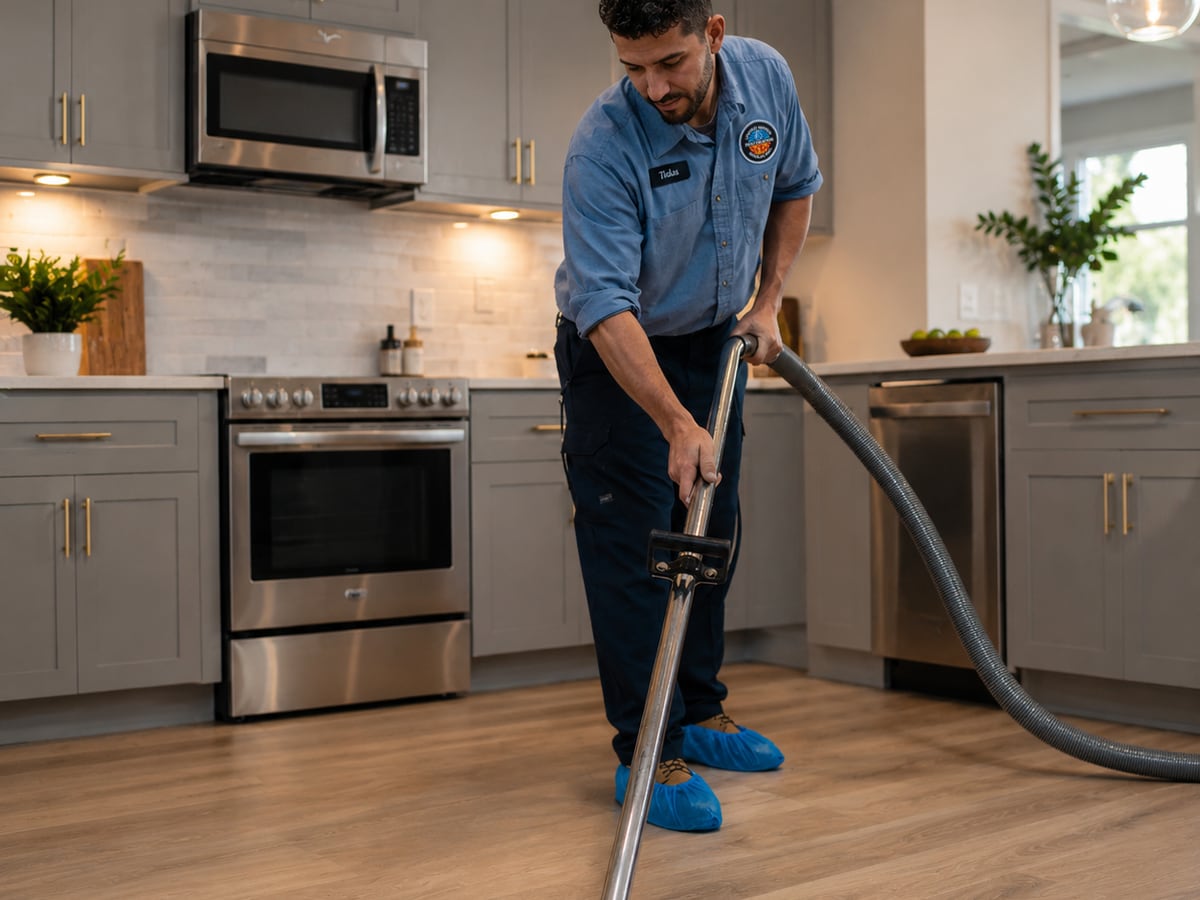
So the order of work matters. We clean the surfaces that are actively reacting first, before the decisions about flooring and drywall are settled: metals, appliance faces, glass, fixtures, cabinet hardware. Different residues need different methods, and the wrong method drives residue in rather than lifting it. Dry, powdery smoke from a fast burning fire comes off with dry sponges and HEPA vacuuming, and wetting it first turns it into a smear. Oily residue from a slow, smouldering fire needs solvent based cleaning worked surface by surface. Protein residue from a cooking fire is nearly invisible, varnishes everything it touches, and is found mostly by smell. We test before we commit to a method, and we tell you plainly which items will clean up and which will not.
Board-up, tarping and the water the fire department left
A fire leaves a building open: broken windows, a hole cut in the roof for ventilation, a door forced at the frame. On this coast the next rain is never far off, and through hurricane season the exposure is not only rain but wind driven water and pressure. An open structure can take on more damage in the week after a fire than it did during the fire, and a carrier expects the owner to prevent that. Board-up and tarping is the first thing our crews do on arrival: plywood over openings, shrink wrap or tarp over the roof cut, the building secured against weather and against anyone wandering in.
Then there is the water. Suppression puts hundreds of gallons into a building in a short time, and that water behaves the way any water loss behaves here. We map it with moisture meters and thermal imaging rather than guessing, because the wet edge is almost never the visible edge. In a raised pier and beam home it runs through floor penetrations into the crawl space, soaks insulation and sits on the vapour barrier, and the first sign upstairs is a soft spot or an odour weeks later. On slab it spreads sideways under the flooring and wicks up the drywall from below, so the room looks fine until the baseboard swells.
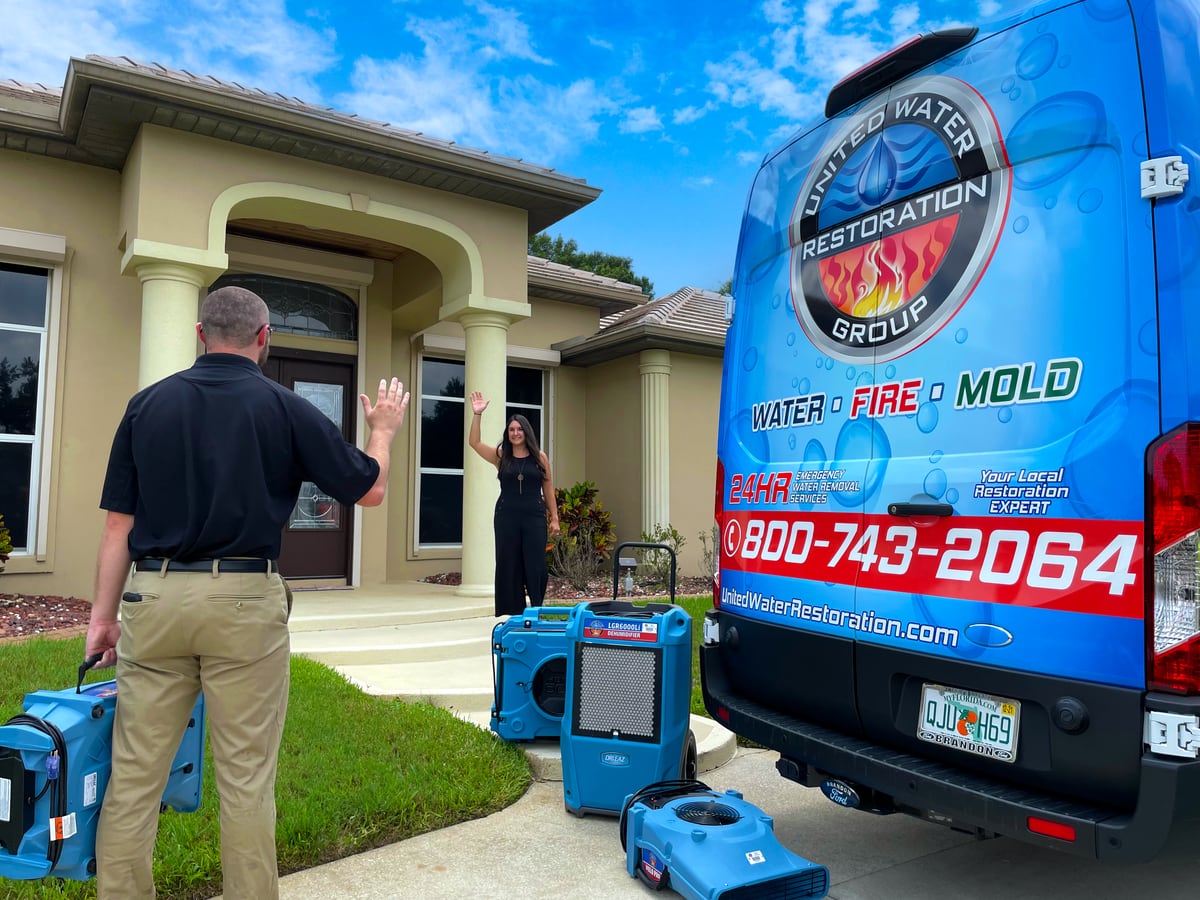
We extract standing water, remove the materials that will not dry in place, and set containment and drying equipment sized to the actual load. Because the air is humid here all year, drying is done with dehumidification rather than by opening the building up, and a structure dried slowly in this climate grows mold with no second leak. Moisture readings are logged daily until the assemblies reach dry standard, and that log becomes part of the file. We follow IICRC S500 for the water side and S520 for anything that has already started to grow.
Containment, air scrubbers and deodorising at the source
Odour after a fire is not a smell hanging in a room. It is residue sitting on surfaces and inside porous materials, releasing constantly. Anything that masks it fails within days, and warm humid air brings it back stronger. The work is removal first and treatment second.
We set containment so the clean side stays clean: plastic barriers at the openings, negative air pressure inside the work area, and air scrubbers running HEPA filtration with carbon so particulate and odour are pulled out of the air instead of pushed through the rest of the building. The HVAC system is shut down and inspected early, because running it after a fire distributes soot into every room on the system and coats both the coil and the duct interior.
Source removal follows the survey. Charred material comes out. Insulation that has absorbed smoke comes out, because it cannot be cleaned in place. Surfaces are cleaned by the method matched to the residue, and framing that held smoke is cleaned and then, where the wood has absorbed odour, sealed with a purpose made sealer after cleaning rather than instead of it. Ductwork is cleaned before the system runs again.
Only then does deodorising make sense. Depending on the material and the residue we use hydroxyl generators, which can run with people and contents present, thermal fogging for oily residues that penetrated the same paths the smoke did, and sealed space ozone treatment in unoccupied structures. We sanitise the surfaces people touch as well, because a fire scene combines residue with suppression water and with whatever was in the refrigerator when the power went out. When we hand a building back, the test is simple. Close it up on a warm day and open it the next morning. If the odour is gone then, it is gone for good.
Contents, pack-out and the claim
Most of what matters in a home is not the home. Contents are handled separately from the structure, and on a fire job that usually means a pack-out. Everything affected is inventoried and photographed room by room, boxed and moved to a controlled space where items can be cleaned properly: ultrasonic cleaning for hard goods, ozone chamber or hydroxyl treatment for textiles and soft goods. With the contents out, the building can be worked on without anything being shuffled from room to room. Items are stored until the structure is ready to take them back. Some things do not survive a fire, and we document those properly so they are paid on the claim rather than argued over.
Documentation is the part people underestimate. Your adjuster is not standing in the building, so the file has to carry it: photographs taken before anything moves, the moisture map and the daily drying log, the inventory with condition notes, the scope of what was removed and why, and the readings showing the assemblies reached dry standard. We write it so a stranger reading it later can follow it.
We work directly with the carrier and explain what we are doing in plain English, not in code numbers. If something we find changes the scope, you hear it before the work happens rather than on the invoice. Crews drive from the office on Halls Mill Road: about twelve miles north to Saraland, fifteen across the bay to Daphne, twenty two to Fairhope, forty to Foley and roughly fifty down to Gulf Shores and Orange Beach. We say that plainly instead of implying a storefront in every town. For a beach unit or a rental sitting empty between guests, we arrange access with the owner or the management company so the work is never waiting on a key.